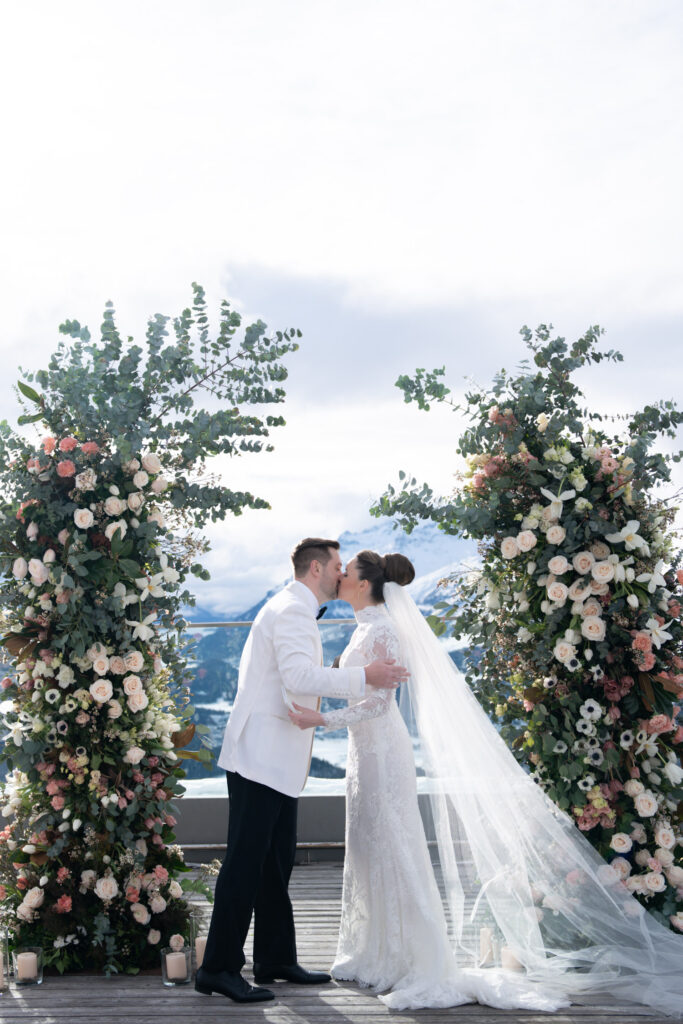
An elopement in the mountains isn't a stripped-down wedding. It's an entirely different way of marrying — one that consciously chooses what's truly important. No hundred guests, no tightly scheduled proceedings, no compromises for others. Instead: two people, an extraordinary mountain backdrop, a photographer who understands the moment — and images that have a lasting impact because they're honest.
More and more couples are opting for an elopement in the mountains — and the reasons are as varied as the people themselves. Some want to escape the machinery of a classic wedding. Some knew from the beginning that a big celebration wasn't for them. Some simply want their wedding day to feel like them — like their story, like their rhythm, like what truly moves them.
The Alps offer a backdrop for a mountain elopement that very few other destinations in the world can replicate. Dramatic peaks, serene mountain lakes, alpine huts with history, larch forests that glow with a golden hue in autumn, snowfields in winter that create a silence you can physically feel. An elopement in the Alps is one of the most powerful decisions of all for the right couples.
This guide is for couples planning a mountain elopement – and who want to understand what this type of wedding really means, which regions are particularly strong, what it costs, and how to plan it so the day feels right.
What is a mountain elopement — and why do couples choose it?
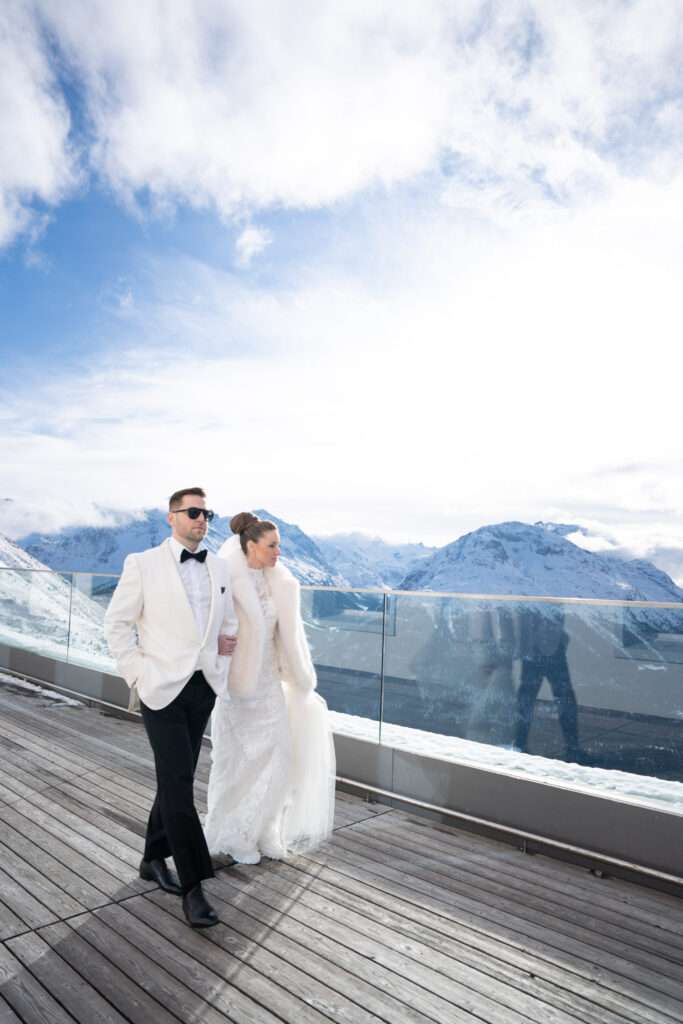
The word 'elopement' originally comes from English and once meant: to marry secretly, without the family's knowledge. This meaning has completely changed. An elopement in the mountains today does not mean secrecy – it means intentionality. The conscious decision to reduce one of the most significant days of life to its most essential elements.
A mountain elopement is not a lesser form of marriage. It is a different one. Those who understand this comprehend why elopements in the Alps are the most powerful way of getting married for certain couples.
Elopement versus a classic wedding – the crucial difference
A classic wedding is, in many ways, a social event. You get married in front of your guests – with all that entails: expectations, compromises, a schedule that caters to many people rather than two. That's not wrong. For many couples, that's exactly right.
An elopement in the mountains is the opposite. No schedule for others. No catering for a hundred guests. No seating plan, no aunt who is offended because she isn't sitting next to her brother. Instead: two people who find themselves in a landscape that is bigger than they are, and who get married in this environment — because they want to, not because they have to.
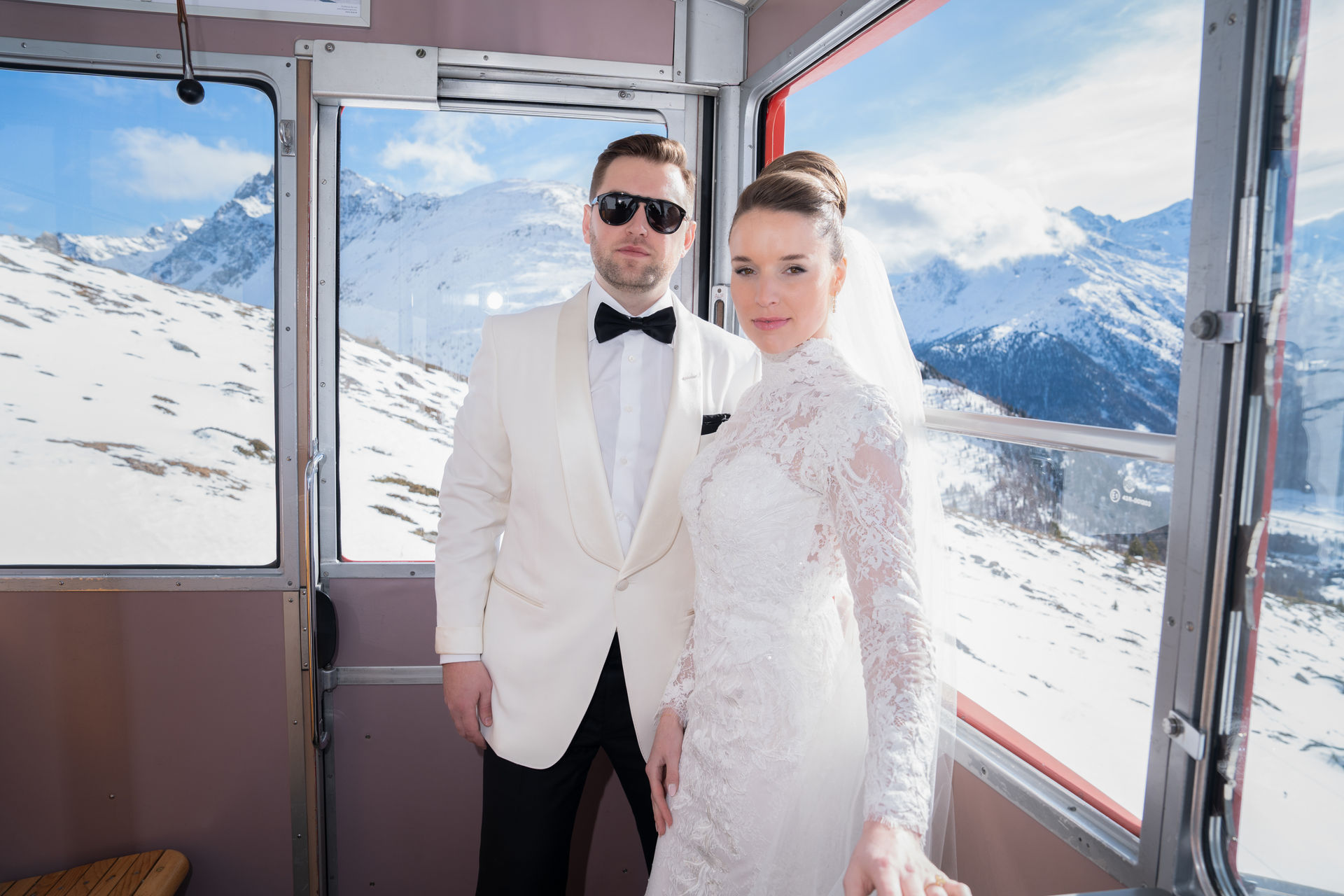
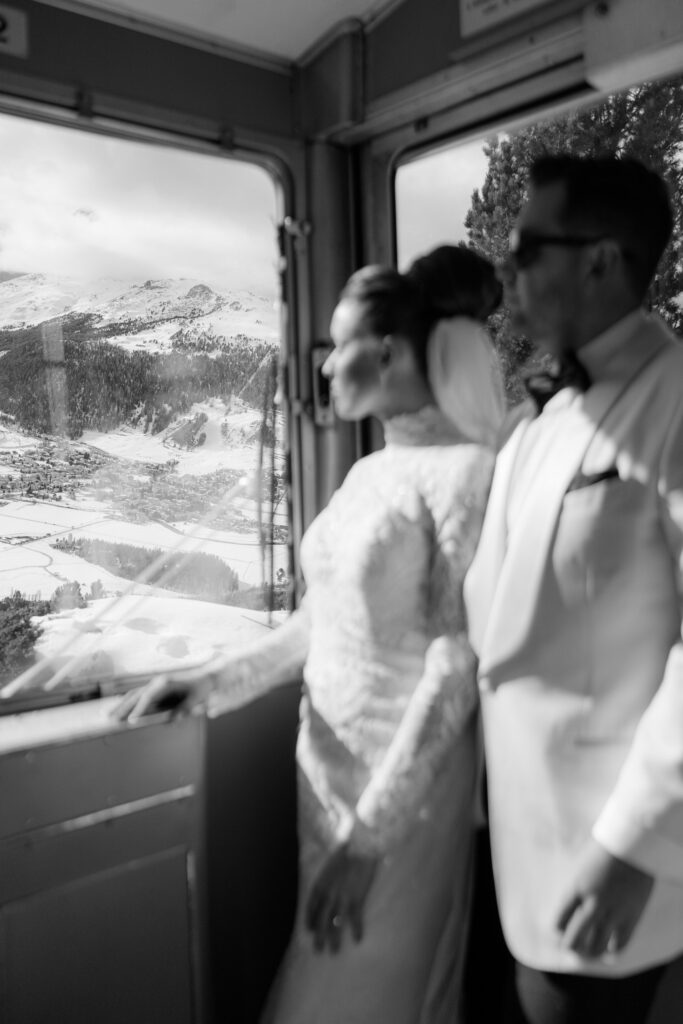
The result is moments of a different calibre. No staged group photos, no obligatory shots, no tired faces at the end of a long programme. Instead, real moments – the laughter as the cable car ascends to the summit, the first glimpse of a mountain landscape never seen before, the silence before the ceremony in a stillness no event location can ever create.
Who a mountain elopement is really for
A mountain elopement is suited for couples who love nature more than ballrooms. Who prioritise intimacy over spectacle. Who know that the most important moment of their wedding day isn't the walk down the aisle in front of a hundred guests, but the instant they look at each other — and it's just the two of them.
It suits couples with a sense of adventure. Those who are prepared to get up early for a sunrise over the Engadin. Those who embrace alpine conditions – weather, trails, unpredictability. Those who understand that it is precisely this unpredictability that often creates the strongest moments.
An elopement in the mountains is also suitable for couples who live internationally — couples who don't have a shared hometown, whose friends and family are spread across different countries, and for whom a wedding day in the Alps is just as easy logistically as any other location.
An elopement in the mountains is not ideal for couples who see celebrating with many people as an essential part of their wedding. For whom a büyük celebration is not a compromise, but a desire. For these couples, a micro wedding or a classic mountain wedding is the stronger choice.
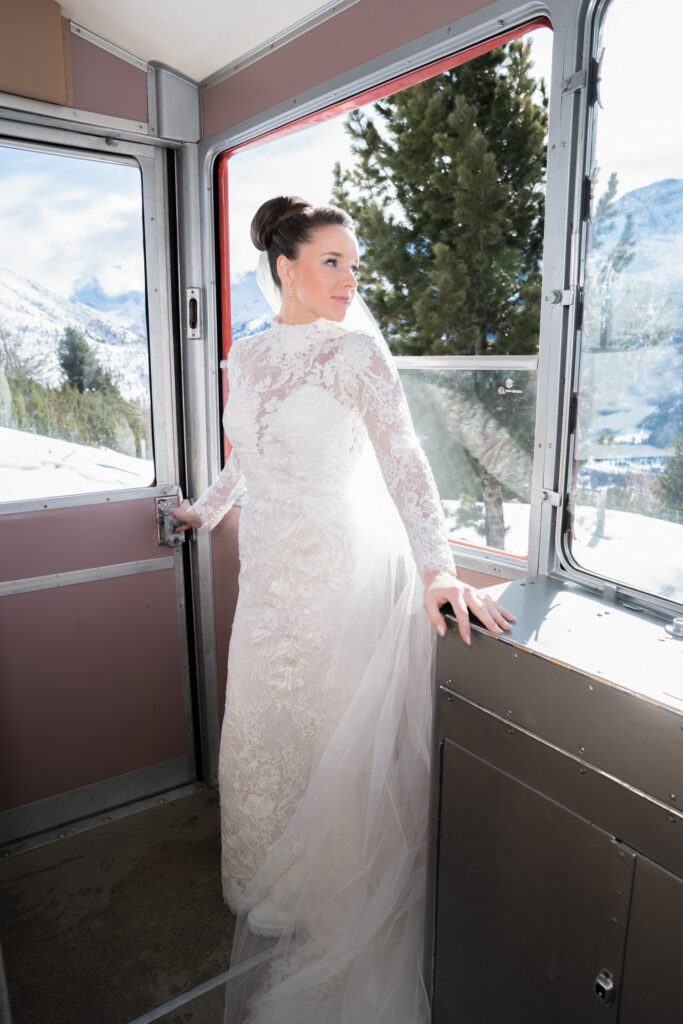

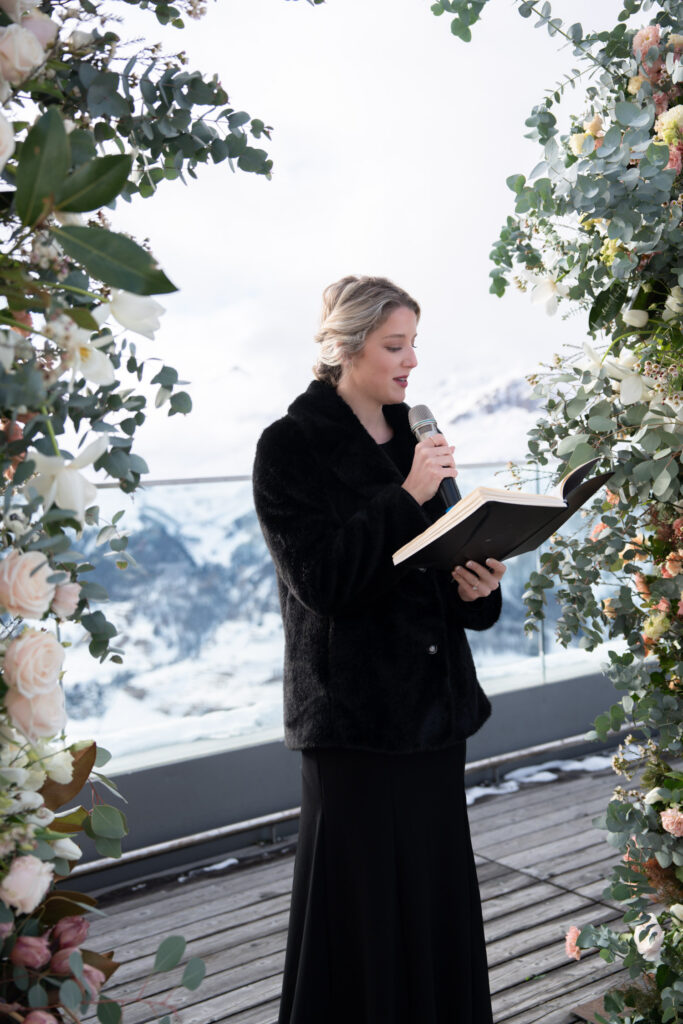
Micro-wedding vs. Elopement in the mountains — where's the difference
The line between an elopement in the mountains and a micro wedding is blurred — but there is a clear conceptual difference.
An elopement in the mountains is, in its purest form, an event for two people – sometimes supplemented by the photographer, a friend as a witness, or the very closest people in a group of no more than five to eight individuals. The focus is entirely on the couple.
A micro-wedding in the mountains is a small but complete wedding celebration — with ten to thirty guests, with a ceremony, with dinner, with an evening reception. Smaller than a classic wedding, but with all the essential social elements.
Both formats have their own strengths. Both work exceptionally well in the Alps. What they have in common: the decision for mindfulness instead of mass, for quality instead of quantity, for a day that feels right instead of one that impresses.
The most beautiful regions for an elopement in the Alps
The Alps are not a homogeneous space. Tyrol feels different to the Engadin. The Salzkammergut to the Dolomites. Vorarlberg to the Bernese Oberland. Those planning an elopement in the mountains must choose a Region decide – and this decision is simultaneously a decision for a specific aesthetic, a specific energy, a specific type of image.
Tyrol — dramatic mountain scenery and alpine authenticity
The Tyrol region is the most dramatic and unspoiled part of the Austrian Alps for a mountain elopement. Wilder Kaiser, Ötztal, Zillertal, Lech am Arlberg – each of these regions has its own personality, but they all share one quality: an alpine authenticity that is rarely found in more developed tourist areas.
An elopement in Tirol means mountains in their purest form. Steep peaks, deep valleys, old alpine huts, cable cars that lead to plateaus that feel like another world. The light in Tirol is more intense than in Salzkammergut - sharper, more contrasting, with a clarity that makes images sharp and deep.
For an elopement in the mountains of Tyrol, this holds true: the most powerful moments happen early in the morning, when the light is still soft and the peaks glow in the first rays of the sun. Those willing to get up early for this moment will get photos that cannot be captured at any other time of day.
Salzburg and Salzkammergut — Lakes, Mountain Panoramas and Gentle Alps
The Salzkammergut is Austria's most romantic and versatile region for an elopement in the Alps. Wolfgangsee, Gosausee, Hallstättersee, Dachstein — the combination of lakes and mountains, of water and peaks, of silence and expanse is unique in its density.
An elopement in the mountains of Salzkammergut feels different from an elopement in the higher alpine regions. Less rugged, less vast — but deeper, quieter, with an intimacy that high peaks don't possess. The lakes mirror the mountains. The light is soft and even. And the accessibility — Salzburg is thirty minutes away — is an almost inestimable advantage for couples from abroad.
Vorarlberg — Alpine Modern on the Swiss Border
Vorarlberg is Austria's westernmost and, in some respects, most modern alpine region – right on the Swiss border, with an aesthetic that differs from other Austrian mountain regions. Lech am Arlberg, the Bregenzer Wald, the Montafon – Vorarlberg is the choice for couples wanting to combine alpine nature with contemporary aesthetics for an elopement in the mountains.
What makes Vorarlberg special for an elopement in the Alps: its accessibility from southern Germany. From Munich Airport, you can reach Lech in two hours. This makes an elopement in the mountains of Vorarlberg logistically simpler for German couples than many other Alpine regions.
The Engadin and Graubünden — Swiss mountains in their purest form
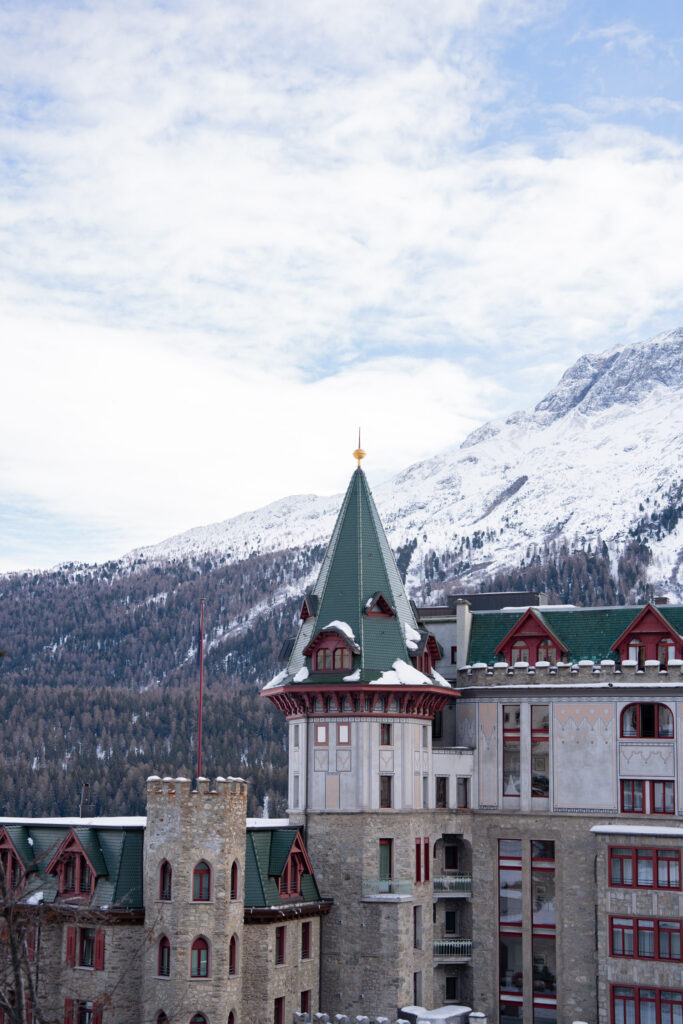
The Engadin is the most exclusive and international Swiss mountain region for an elopement in the mountains. St. Moritz, Pontresina, Maloja, Soglio — the Engadin has a vastness and a quality of light that cannot be replicated by any other alpine region.
The Engadin is located at over 1,700 metres above sea level — this means a different kind of air. Clearer, cooler, with a transparency that makes colours more intense and contours sharper. The light in the Engadin — especially in winter, when the sun is low and the surrounding snow reflects everything — is photographically exceptionally powerful for an elopement in the mountains.
An elopement in the Alps in the Engadin is for couples seeking alpine silence in its purest form. They are not looking for the accessibility of Tyrol or the romance of the Salzkammergut, but something more radical: a landscape so vast it makes you feel small – and where this moment of smallness becomes something meaningful.
Berner Oberland — Jungfrau, Grindelwald and iconic peaks
The Bernese Oberland is the most internationally renowned mountain region in the Alps — Jungfrau, Eiger, Mönch, Grindelwald, Oeschinensee. For a mountain elopement, the Bernese Oberland is the choice for couples who want to combine recognisability with alpine drama.
What sets the Bernese Oberland apart from other regions for a mountain elopement: the iconic backdrop. The Jungfrau, the Eiger – these mountains are world-renowned. Photos against this backdrop have a layer of significance that regional peaks lack. For couples with international backgrounds who have guests from various countries, this is a real advantage.
South Tyrol — Mediterranean warmth meets alpine heights
The South Tyrol is the most colourful and warmest mountain region for an elopement in the Alps. Dolomites, Alpe di Siusi, Tre Cime di Lavaredo, Lago di Braies — South Tyrol unites Mediterranean warmth with Alpine drama in a combination that doesn't exist in the Northern Alps.
An elopement in the mountains of South Tyrol is for couples who want to combine mountain scenery and southern light. The colours of the Dolomites — the reddish rock, the intense green of the meadows, the contrast between rock and sky — are photographically exceptionally striking. The light is warmer than in Tyrol or the Engadin. And the proximity to northern Italy makes South Tyrol a natural starting point for couples planning a combination of the Alps and Italy.
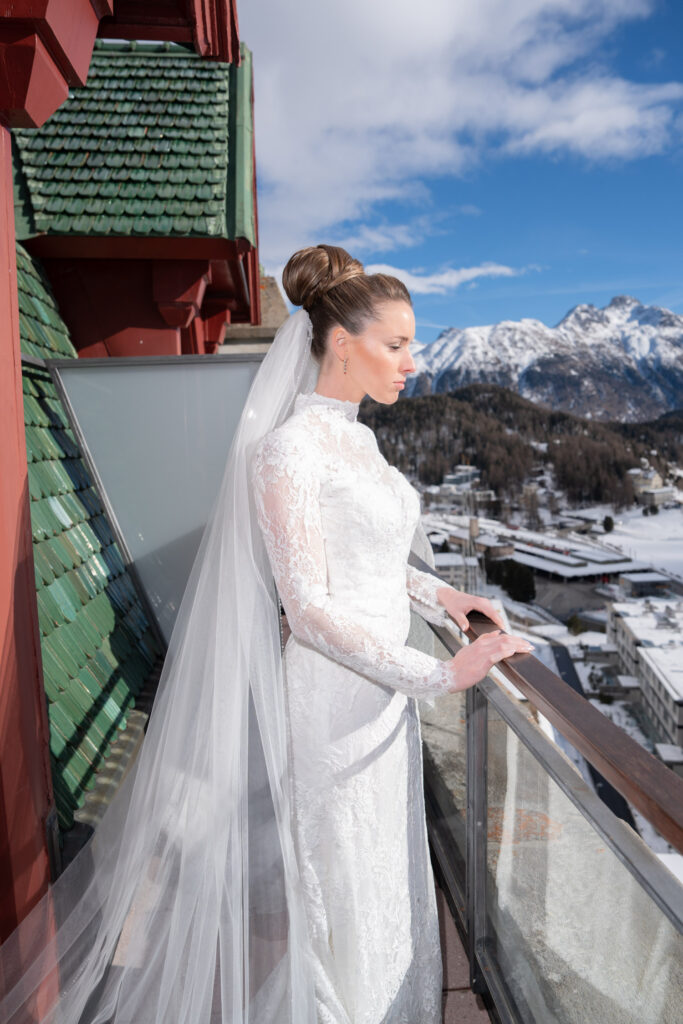
What makes an elopement in the mountains so exceptionally photographic
As Photographer, Having accompanied elopements in the mountains, I can say: no other wedding photography format produces images of this quality. Not because I'm a better photographer – but because the location contributes more. The mountains work with you, not against you.
The light in the mountains — harder, clearer and, at the right moments, extraordinary
The light in the mountains is fundamentally different from any other light I photograph in. It is more direct, clearer, more intense – and, in the right moments, so extraordinary that it almost makes the photographer's job redundant. You just have to be there.
What this specifically means for an elopement in the mountains: the best moments don't happen at midday. Midday light in the Alps is harsh and high-contrast – difficult for portraits. The best moments happen early in the morning, when the first light appears over the peaks. At sunset, when the alpenglow colours the mountain flanks pink and orange. And when the sky is cloudy, when the light becomes soft and even, and the colours of the landscape become visible in their full depth.
An elopement in the Alps, planned around the light and timing, will capture images of a quality that cannot be replicated by the most beautiful midday sun shoot.
Sunrise Elopement in the Mountains — Why Getting Up Early is Worth It
A sunrise elopement in the mountains is the most powerful format there is – and at the same time the rarest, because most couples shy away from the effort involved. Those who get up at four in the morning to be at the summit on time get something that no other format can produce: the very first light of the day on a mountain peak, complete solitude, and an atmosphere that can hardly be described in words.
Sunrise elopements in the mountains work particularly well in autumn and winter – when the sun rises later and the temperatures make the air crystal clear. A couple on a mountain peak at sunrise, alone with the photographer, in a landscape that is still sleeping – these are moments for which there is no second chance.
Fog, clouds and bad weather — why they create the most powerful images
One of the most common misconceptions when planning a mountain elopement is the assumption that good weather is a prerequisite for good photos. The opposite is often true.
Mist lying over mountain lakes. Clouds that drift over peaks and make them disappear. A rainbow after a brief thunderstorm. A snowstorm that sets in and turns everything white. These are the moments mountains are known for — and the moments when images are created that defy any generic category.
Those planning an elopement in the Alps and waiting for perfect weather are often waiting in vain. Those who instead accept the weather as an active part of the story will receive pictures that are atmospheric and emotional on a level that good-weather photography rarely achieves.
Season and imagery – how a mountain elopement differs depending on the season
Each season creates a completely different visual language in the mountains – and with it, a completely different type of mountain elopement.
Summer means: green alpine meadows, wildflowers, clear lakes, long evenings with soft alpine light. A summer elopement in the mountains is the most accessible and visually freshest format — with a vibrancy and colourfulness that other seasons don't have.
Autumn means: golden larches, red blueberry bushes, fog in the valleys, a light that is deeper and warmer than in summer. Autumn elopements in the mountains are photographically the strongest – October in the Alps, when the larches glow, is a season for which you don't need any staging.
Winter means: snow, silence, a purity that is physically palpable. A winter elopement in the mountains creates images that are completely different from summer and autumn shots — more minimalist, quieter, with a depth that warmer seasons cannot achieve. And with an atmosphere that makes a winter Alpine elopement something fundamentally different from any other wedding format.
How to plan a mountain elopement — what you need to know
Planning an elopement in the mountains is easier than a traditional wedding - but not without preparation. This section gives an honest overview of everything you need to know.
Civil ceremony and celebrant-led ceremony – how it works legally
The most common question when planning a mountain elopement: how do we get legally married? The answer is simpler than many people think.
For German couples planning an elopement in the Alps – whether in Austria, Switzerland, or South Tyrol – the most practical solution is: a civil wedding beforehand in Germany, followed by a free, symbolic ceremony in the mountains. The civil wedding is the legal act; the ceremony in the mountains is the emotional centrepiece of the day. This combination offers complete creative freedom – without bureaucratic dependencies on foreign authorities, and without time pressure from documentation processes.
If you want to get legally married in the mountains - for example in front of an Austrian registrar at an alpine hut - this is possible, but requires lead time and coordination with the responsible municipality. An experienced wedding planner can help with this.
Permits and protected areas — what you need to know in the Alps
Elopements in the mountains often take place in nature – and nature in the Alps is frequently protected. National parks like Hohe Tauern in Austria or Berchtesgaden National Park have clear regulations for events. Private alpine pastures, nature reserves, and certain summit regions can also have restrictions.
What an elopement in the Alps specifically means: Before planning, it should be clarified whether the desired location is accessible and if a permit is necessary. An experienced local wedding planner or photographer who knows the region can help with this – and often knows locations that are legally accessible and at the same time extraordinary.
Getting there and logistics — Gondolas, mountain railways and alpine paths
An elopement in the mountains requires different logistical planning than a wedding in a city or on a lake. Cable cars and gondolas have fixed operating times - especially for sunrise elopements in the mountains, you often have to walk up or organise a private transfer. Routes can be more difficult than expected depending on the time of year and weather conditions.
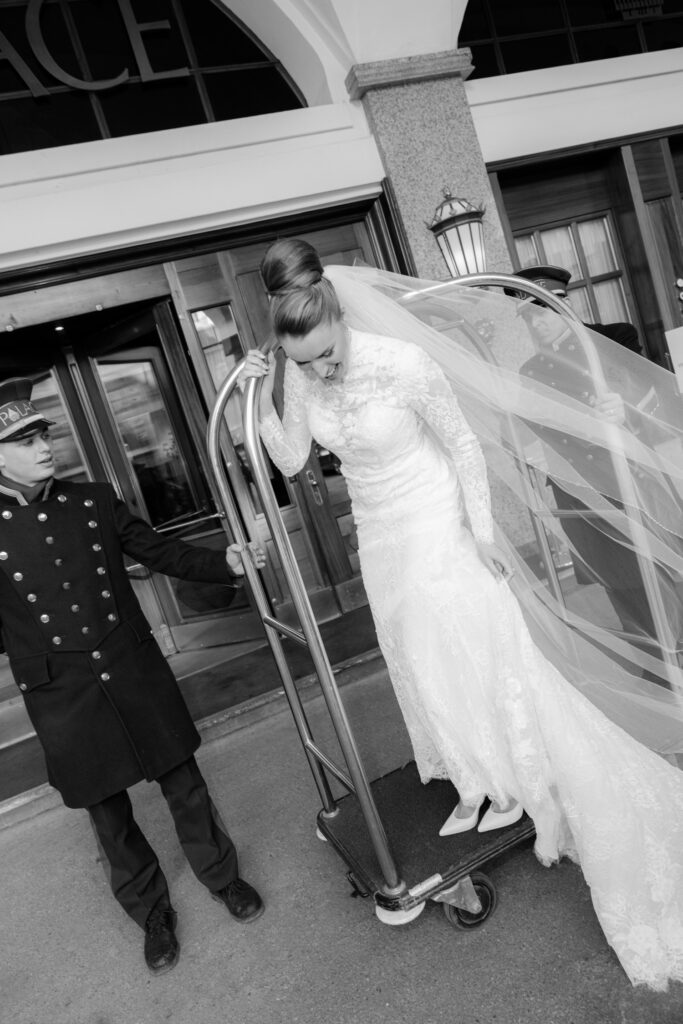
What this means for clothing: an elopement up mountains in a long drag dress on a stone path at 2,500 metres is possible - but only with the right preparation. The right footwear for the ascent, a dress that is suitable for alpine conditions, weather protection just in case - these are practical considerations that make a big difference.
As a photographer for elopements in the mountains, I bring all my own equipment - no tripods to block the way, no equipment that restricts mobility. The focus is on lightness and presence, not on set-up and logistics.
Weather and Plan B — how to plan a weather-proof elopement in the mountains
Mountain weather is unpredictable - that's not a limitation, it's a fact. Planning an elopement in the mountains means taking this factor into account from the outset.
A good plan B for an Alpine elopement is not a retreat to the valley - it is an alternative location at a different altitude that offers other possibilities in bad weather. Often the strongest images of an elopement in the mountains are the ones taken in unforeseen weather conditions. A snow shower that starts. A fog that rolls in. A rainbow spanning the valley. These are moments that no schedule can dictate - and that's why they are so powerful.
What to wear for a mountain elopement
The question of attire is more complex for an elopement in the mountains than for a traditional wedding — and at the same time, one of the most exciting. Because there are no conventions here.
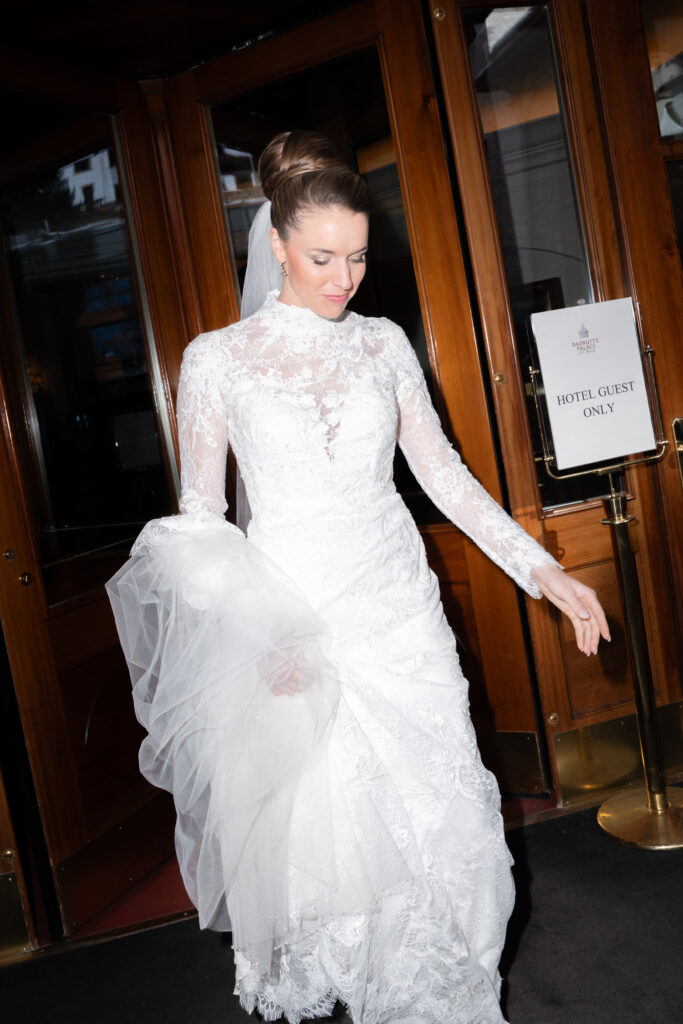
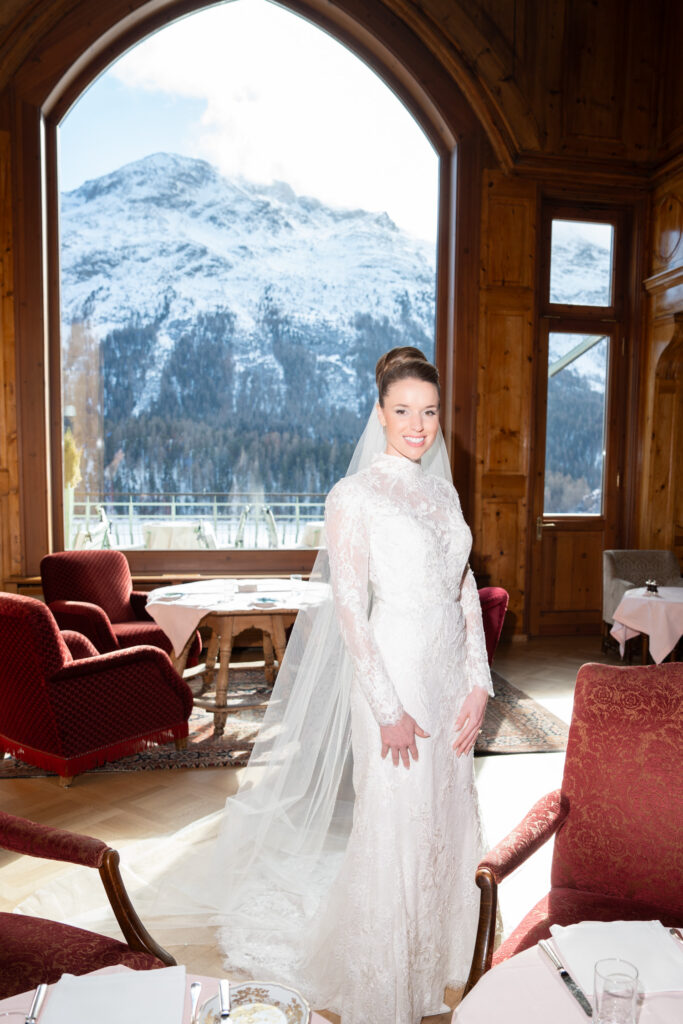
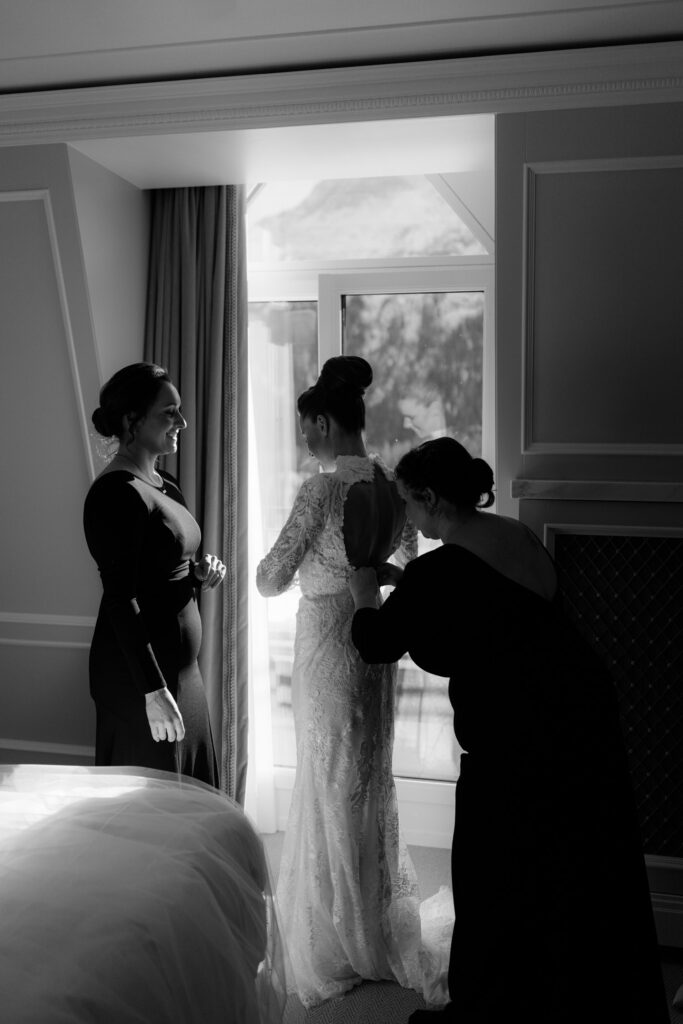
For her: Wedding dresses for an elopement Mountains are strongest when they fit the surroundings - not in the sense of costume, but in the sense of proportion and movement. Flowing dresses that move in the mountain breeze. Dresses that are not too heavy for alpine paths. Or an elegant jumpsuit that is perfect for the mountains and still looks wedding-worthy. The most important thing: shoes that really work - beautiful mountain shoes are not a compromise, they are the right choice.
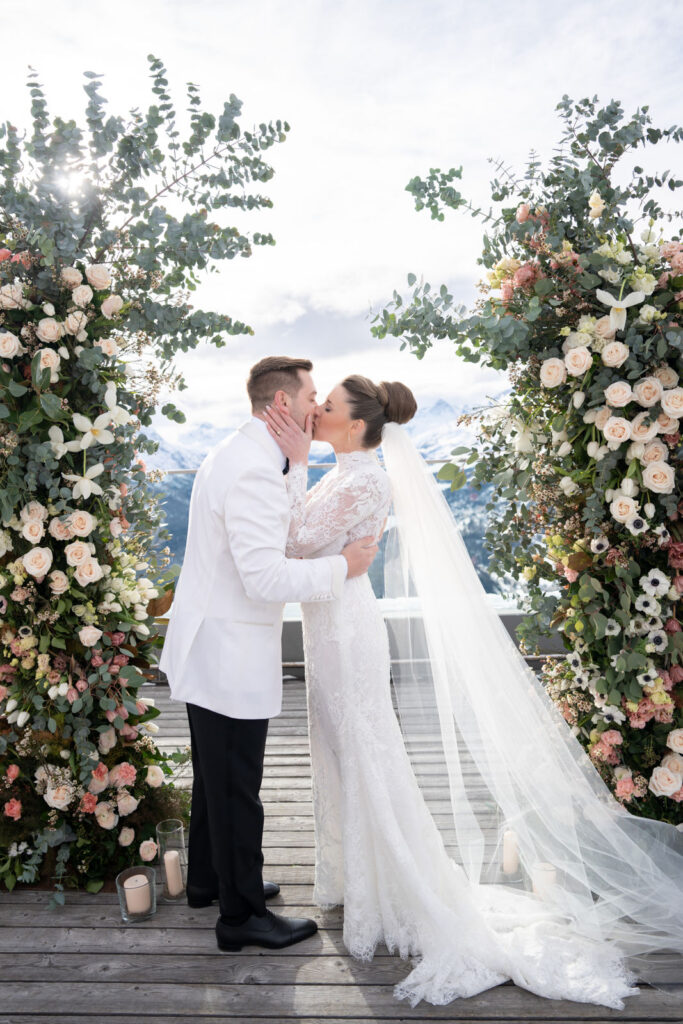
For him: A classic suit in a mountain setting is strong - the contrast between formality and wildness creates a visual language that works immediately. A linen suit in natural colours blends in with the surroundings. Traditional costume can work if it suits the couple - but only if it's authentic, not because you're in the mountains.
Eloping in the Mountains — The Best Locations and Spots
There is no best location for an elopement in the mountains. There is the right location for the right couple - and that decision depends on what the couple is looking for.
Alpine huts and mountain chalets — Intimacy of the highest level
An old alpine hut for an elopement in the mountains is sometimes stronger than any luxury location. The weathered wooden facades, the flower meadows in front, the mountain panoramas behind - this is a setting that carries history and at the same time enables complete intimacy.
Alm huts for an elopement in the Alps are particularly suitable for couples who prioritise authenticity over glamour. Those who seek the raw, the genuine, the unmediated. A ceremony in an alpine meadow, with a hut behind and a mountain panorama in front – this is an image that defies categorisation within the wedding spectrum.
Summits and viewing platforms - Elopement above the clouds
An elopement on a mountain top is the most radical format - and the strongest for the right couples. You're above the clouds. Literally. No noise, no other people, just rock and air and the feeling that the world is infinitely wide.
Summit elopements in the mountains require more planning — cable car times, weather windows, physical fitness in case of hiking up. But what is created is irreplicable. A couple getting married on a summit is getting married in a place where not many people have ever stood. This gives a mountain elopement a layer of meaning that no other format can achieve.
Lakes and mountain lakes – water and mountains in combination
Mountain lakes for an elopement in the Alps are in a category of their own. Lake Gosau in front of the Dachstein. Lake Oeschinen in the Bernese Oberland. Lake Braies in South Tyrol. The Schrecksee in the Allgäu. These lakes have a tranquillity and a visual quality that high Alpine peaks do not have - the water reflects the mountains, the light refracts on the surface and the combination of water, rock and sky creates compositions that arise of their own accord.
A mountain elopement by a mountain lake is for couples who want to combine mountain drama and tranquillity. Who want a reflection in the water. Who are looking for a setting that is quieter than a summit, but deeper than an alpine meadow.
Larch forests in autumn – the golden season for an elopement
October in the Alps is one of the most photographically exceptional times of the entire year – and the reason is the larch. Larches are the only conifers that lose their needles – and before they do, they glow with a golden hue that has few parallels in nature.
Larch forests for an elopement in the mountains in October — in Tyrol, in Engadin, in Graubünden — are locations that require no staging. You stand among golden trees, with mountain panoramas behind, in a light that is warm and deep and unforgettable. This is the most powerful natural stage that the Alps have to offer for an Alpine elopement.
The cost of an elopement in the mountains — realistic estimate
An elopement in the mountains is in almost all cases significantly cheaper than a classic wedding - but not free. This section provides a realistic orientation.
Cost comparison - elopement vs. classic wedding
A classic wedding in Germany costs on average between €15,000 and €30,000 — excluding any destination surcharge. A classic luxury destination wedding can cost five to ten times that.
An elopement in the mountains costs a fraction of that. No venue hire for a hundred guests. No catering for a large party. No table decorations, no floral arrangements costing thousands of pounds. Instead: a photographer, a certificate, perhaps a celebrant for the ceremony, travel costs, an exceptional dinner for two afterwards.
Realistic total costs for a mountain elopement — including a photographer, travel expenses, a small ceremony, and a dinner for two — start at around €3,000 to €5,000. For more extensive elopements with multiple days, analogue photography, and special locations, the costs range between €5,000 and €15,000.
What truly matters for an elopement in the Alps
When having an elopement in the mountains, there is one clear priority: the photographer. The pictures are the only thing that will remain from this day – and a photographer who knows mountain elopements, understands light, knows when to wait and when to act, makes the biggest difference of all.
After that comes the location – not in the sense of money, but in the sense of research. Finding the right location for the right couple is not a question of budget. It is a question of knowledge and diligence.
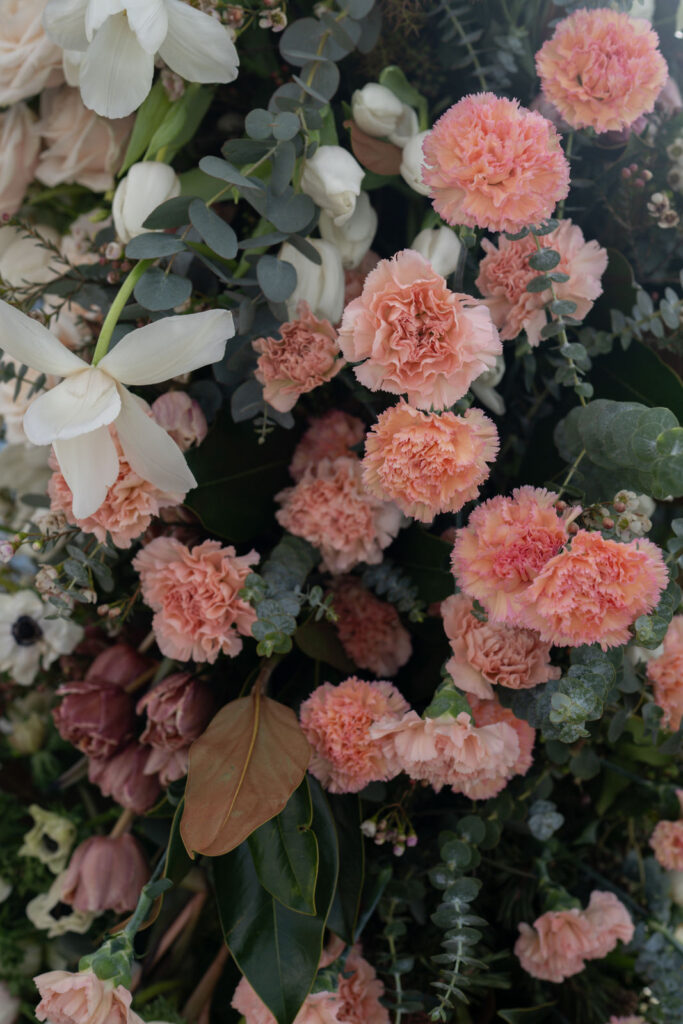
A small bouquet of wildflowers from the mountain meadow. A celebrant who knows the couple and holds a ceremony that feels like them. A dinner for two afterwards in an unforgettable mountain restaurant. These are the investments that truly make an impact on a mountain elopement.
My approach as an elopement photographer in the mountains
I facilitate elopements in the mountains with the same approach I bring to any work: observing rather than orchestrating, precise rather than loud, and with a deep understanding of light and moment, which is the foundation of every good shot.
An elopement in the mountains is the format that gives me as a photographer the greatest freedom – and at the same time requires the greatest concentration. No group photos, no obligatory shots, no schedule for others. Just the moment, the landscape, and the two people within it.
Why I love elopements in the mountains
For me as a photographer, the mountains are the most powerful place there is. Not because the scenery is impressive – although it is, but that alone isn't enough. It's because an elopement in the mountains creates a form of focus that I rarely experience elsewhere.
When two people stand on a mountaintop, alone, in a landscape that is bigger than anything they know – something happens to them. The distractions disappear. The expectations disappear. What remains is the essential: them, with each other, in this moment. And that is precisely what I want to photograph.
How we'll plan your elopement in the mountains together
A collaboration for a mountain elopement begins with a conversation — not about packages and prices, but about you. Which region draws you in? What is important to you — the stillness of a mountain lake, the drama of a summit, the warmth of a larch forest in autumn? Are you craving sunrise, or do you need evening light?
A concept emerges from this conversation – an idea of what your elopement in the mountains could look like. Not rigid planning, but a framework that leaves room for what the day brings. Because the strongest moments of an elopement in the mountains are never planned. They happen because you are ready to see them.
Elopement in the Alps with analogue photography — why film is particularly powerful in the mountains
I photograph elopements in the mountains using a combination of digital and analogue – and for certain moments, film is the stronger choice.
The light in the mountains, especially at sunrise and during the golden hour, is exceptionally well-suited to film photography. Analogue material captures the grain, warmth, and depth of this light in a way that cannot be fully replicated digitally. An elopement in the Alps on film has a visual language that feels like a memory – not a documentation.
For couples interested in a mountain elopement with analogue photography, I offer the opportunity to capture specific moments – the ceremony, couple portraits during the golden hour, and intimate close-ups – on film. The result is a combination: the completeness of digital documentation and the special quality of analogue material.
Conclusion – why an elopement in the mountains is one of the strongest decisions
An elopement in the mountains is one of the most extraordinary decisions for the right couples. Not because it's spectacular – although it often is. But because it's honest.
It's a decision that says: This day belongs to us. Not to the expectations of others, not to the social pressure of a guest list, not to the fuss of an event for a hundred people. This day belongs to us — and we're spending it in a place that's bigger than us, in a landscape that reminds us why silence is sometimes louder than any music.
The Alps offer a backdrop for a mountain elopement that no other destination in the world can provide in quite the same way. The silence. The light. The natural beauty. The fact that you are standing by a mountain lake, or on a summit, or in a golden larch forest – and that this place exists, independent of what you pay for it or plan for it.
Anyone planning an elopement in the mountains – whether in Tyrol, the Salzkammergut, the Engadin, or the Dolomites – will find all the information on regions, locations, and planning details in the further guides on getting married in Austria and getting married in Switzerland.
And whoever a Photographer seeks to accompany elopements in the mountains with the same respect and attention that this form of marriage deserves — I am delighted to hear from you.